At an AI and technology summit, driving Maharashtra's digital future
Three portfolios transforming Maharashtra — Information Technology, Cultural Affairs, and Education.
In January 2025, Shelar directed IT Department officials to draft Maharashtra's first independent Artificial Intelligence Policy — a move that positioned the state ahead of every other Indian state in AI governance readiness. He formed a 16-member AI Policy Taskforce comprising senior bureaucrats, industry leaders, academic researchers, and domain experts from cybersecurity, healthcare, and urban planning.
The vision: position Maharashtra's ₹6 lakh crore digital economy toward the state's ambitious $1 trillion GDP target. The policy framework is built around five strategic pillars: (1) AI-enabled citizen services across 36 districts, (2) AI-driven agricultural innovation for Maharashtra's farming communities, (3) AI-powered urban governance for Mumbai, Pune, and Nagpur, (4) AI talent pipeline through university partnerships, and (5) robust AI ethics and data governance standards.
Maharashtra's policy is designed to complement the central government's India AI Mission (₹10,372 crore budget) — combining national frameworks with state-level entrepreneurial energy. The state aims to create 50,000 AI-related jobs by 2030 and establish Maharashtra as the preferred destination for global AI research labs seeking to operate in India. The AI Policy launch was targeted for April 2025, with implementation phased across three fiscal years.
In February 2025, Shelar announced the formation of a task force to establish India's first Artificial Intelligence University in Maharashtra. Designed as a centre of excellence rather than a conventional degree-granting institution, the university will promote deep collaboration between industry, academia, and government — positioning Maharashtra as a global AI leader and talent producer.
The university's curriculum vision encompasses not just machine learning and neural networks, but applied AI in governance, healthcare diagnostics, agricultural optimization, regional language NLP, and ethical AI frameworks — domains where India can lead globally. The institution will partner with leading international AI labs and offer industry-embedded research programmes. Site selection and regulatory approvals are underway, with the first cohort targeted for the 2026–27 academic year.
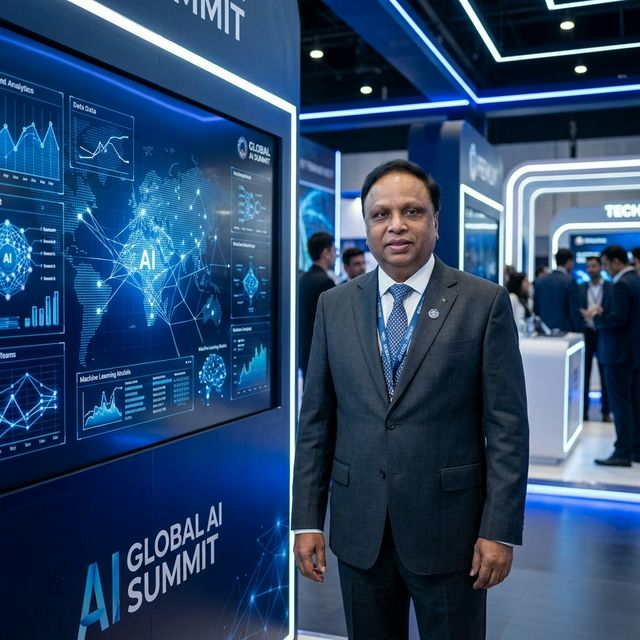
Shelar delivered a keynote at the AI Impact Summit 2026, held at Bharat Mandapam, New Delhi (February 2026). His presentation, titled "Maha AI: Building Safe, Secure & Smart Governance," articulated a core message: AI is not just a technological revolution but a medium to strengthen democracy.
Maharashtra's approach, as presented at the summit, centres on smart, secure digital governance that serves citizens — not surveillance architecture but service infrastructure.
Shelar amended government resolutions to crack down on unmonitored private IT consultants in Mantralaya who were described as leading to financial irregularities and security vulnerabilities. By mandating transparent procurement processes and regular security audits, he is bringing accountability standards to state IT infrastructure that were previously absent.
He stated in the Legislative Assembly that through technology, a "progressive and developed Maharashtra" meeting citizen expectations will be created — a vision that encompasses digital citizen services, paperless governance, and data-driven policy making across all state departments.
He also directed BMC to adopt technology norms for urban infrastructure — bringing modern GIS mapping, IoT-enabled water management, and AI-powered traffic management systems to Mumbai's civic governance. This directive extends to all municipal corporations in Maharashtra, creating a standardized digital governance framework for the state's 30+ urban local bodies.
"The AI era has begun. Maharashtra must seize this opportunity to drive economic growth and strengthen its global position." — Ashish Shelar, January 2025
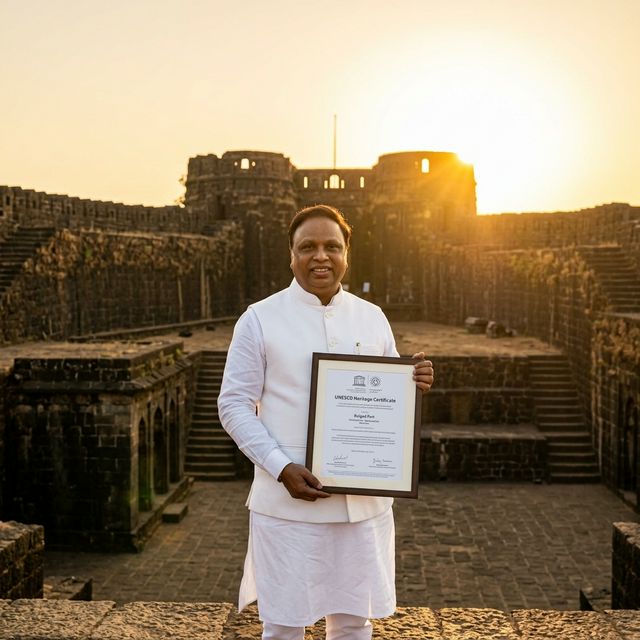
In July 2025, UNESCO at its 47th session inscribed 12 forts from the era of Chhatrapati Shivaji Maharaj on the World Heritage List under the title "Maratha Military Landscapes of India."
In February 2025, Shelar led a four-member Maharashtra delegation to Paris to present the technical and strategic case before UNESCO. In February 2026, he visited Paris again to formally receive the World Heritage certificate. During the visit, he paid homage to the half-bust statue of Dr. B.R. Ambedkar at UNESCO Headquarters — installed by Maharashtra's Cultural Affairs Department.
He held meetings with the Director-General of UNESCO, subject experts, and India's Permanent Representative. Shelar is now pursuing World Heritage recognition for Konkan rock art, Maharashtra's sea forts, and intangible cultural heritage traditions including Pandharpur Wari, Ganeshotsav, and Dahi Handi.
Diwali was included in the UNESCO Intangible Cultural Heritage list — announced in the Maharashtra Assembly in December 2025.
In October 2025, Shelar directed preparation of a comprehensive roadmap for conservation of 500 temples across Maharashtra, 60 state-protected forts, 1,800 stepwells (baravs), and an additional 350 non-protected forts.
The Archaeology Department was designated as the nodal agency, in collaboration with Maitree. Destination Management Organisations (DMOs) will be established in Pune, Chhatrapati Sambhajinagar, and Nashik.
The first phase, targeted for completion by March 2026, covers 15 heritage destinations — 5 stepwells, 5 temples, and 5 forts — under the Destination Management framework. Funding will flow through PPP models, government budgets, and potentially international agencies including the World Bank and ADB. MITRA (Maharashtra Institution for Transformation) is supporting the roadmap for funding mechanisms.
In December 2025, the State Cabinet established a State-Level Committee chaired by Shelar to clear encroachments from all 390 state-protected monuments. The GR expanded scope from forts only (January 2025 GR) to all state-protected monuments plus 145 temples. The Planning Department was authorized to provide funds directly to District Collectors for encroachment removal.
MAHARA Awards (February 2025) — recognizing contributions in visual arts, performing arts, and literature to foster emerging talent. Announced at inauguration of "Art of India" event in Mumbai.
Modi Script & Persian Script Promotion Awards (March 2026) — ₹1 lakh prize each — to encourage research, documentation, and promotion of historically significant scripts used during the Maratha period.
Ganeshotsav officially declared a state festival (11 July 2025) — ₹10 crore dedicated cultural programming, with government departments directed to organize theatre, music, and awareness campaigns.
Deep Utsav — Diwali Pahat at Kalidas Natyagruha, Mumbai, as flagship cultural event. An annual plan to host 1,200+ cultural events statewide — performances, exhibitions, and festivals coordinated by the Cultural Affairs Directorate.
In August 2025, Shelar presented to the Governor a book containing unpublished letters of Chhatrapati Shivaji Maharaj, alongside Chief Minister Fadnavis.
Shelar's cultural affairs portfolio reflects a governing philosophy where heritage preservation is not nostalgia but active nation-building. The emphasis is on:
Shelar served as Minister of School Education, Sports & Youth Welfare during the Devendra Fadnavis administration in 2019. Though the ministerial tenure was brief — ending with the formation of the MVA government — the focus areas laid important groundwork.
He initiated reforms to enhance educational outcomes by integrating proactive learning methodologies with traditional academics. He advocated strongly for reading culture and library development, particularly to counter the adverse effects of excessive screen time and gadget use among young people.
Shelar also warned against blind reliance on AI-generated data in educational contexts, stating: "No information generated by AI is certified by the state or Union government, making it risky to trust such data unverified."
The focus areas — reading, libraries, youth development — have continued into his current Cultural Affairs portfolio, reflecting a consistent vision for knowledge-driven public engagement.